
[2026 Updated] How to Compress Your PDF File for Easy Email Sending?

Summary
This guide covers multiple approaches to how to compress PDF files, including online tools for quick results, offline desktop software for greater control and privacy, and mobile options for on-the-go use. Additional sections address creating smaller PDFs at the source, batch processing, and security considerations.
Table of contents

| Scenario | Typical limit | First-choice method | Backup method | Notes (quality/privacy) |
|---|---|---|---|---|
Email attachments |
20–25 MB (typical) |
Online tool |
Desktop (Renee PDF Aide/Acrobat) if blurry |
Balance speed and clarity; check carrier/app limits |
Government portals |
≤1MB/≤500KB/≤100KB |
Offline desktop (Renee PDF Aide or Acrobat) |
Split by size/pages + recompress |
Avoid uploading sensitive IDs to third-party sites |
Scanned PDFs (image-heavy) |
Often ≤1–2 MB |
Scan at 150–200 DPI, grayscale, OCR → then compress |
Acrobat custom settings or Renee PDF Aide with OCR |
OCR preserves readability at smaller sizes |
Mobile-only user |
Varies |
Mobile web compressor, Strong if needed |
Native app with offline compression |
Prefer Wi‑Fi, watch data permissions |
“Compress to 1MB/500KB/100KB” |
As stated |
Start Medium → Strong iteration |
Downsample images and/or split |
Check size after each pass; avoid over-blur |
- Lower DPI and higher compression reduce size but may blur images; OCR helps keep text crisp.
- Privacy-sensitive → offline first; time-sensitive → online first.
- No installation required
- Fast results with simple 3-step workflow
- Works on most devices and browsers
Disadvantages:
- Sensitive files shouldn’t be uploaded
- Daily caps or file size limits on free tiers
- Quality may vary; stronger levels can blur images
- Some tools require sign-in after a few tasks
Online tool comparison (free tiers)
| Tool | Max file size (free) | Free usage limits | Compression levels | Batch support | Sign-in required | Auto deletion policy | Mobile web friendly | Notes |
|---|---|---|---|---|---|---|---|---|
Smallpdf |
Up to 5 GB |
Daily task cap (e.g., a few actions/day) |
Strong, Recommended/Basic |
Single-file in free web tool |
Sometimes after first task |
Deletes shortly after processing (e.g., ~1 hour) |
Yes |
Strong brand, 14‑day trial removes caps |
iLovePDF |
Up to 200 MB (typical) |
Daily cap on free tasks |
Extreme, Recommended, Less |
Yes, multi-file to ZIP |
No for basic use |
Auto-delete after a short period (e.g., ~2 hours) |
Yes |
Mobile apps available (iOS/Android) |
Adobe Acrobat Online |
Up to 2 GB (typical) |
Repeated tasks may require Adobe ID |
High, Medium (Recommended), Low |
No (one file at a time) |
Often required for repeat use |
Auto-delete after processing/limited time |
Yes |
Trusted privacy stance, clean results |

Convert to Editable Word/Excel/PPT/Text/Image/Html/Epub
Multifunctional Encrypt/decrypt/split/merge/add watermark
OCR Support Extract Text from Scanned PDFs, Images & Embedded Fonts
Quick Convert dozens of PDF files in batch
Compatible Support Windows 11/10/8/8.1/Vista/7/XP/2K
Convert to Editable Word/Excel/PPT/Text/Image/Html/Epub
OCR Support Extract Text from Scanned PDFs, Images & Embedded
Support Windows 11/10/8/8.1/Vista/7/XP/2K
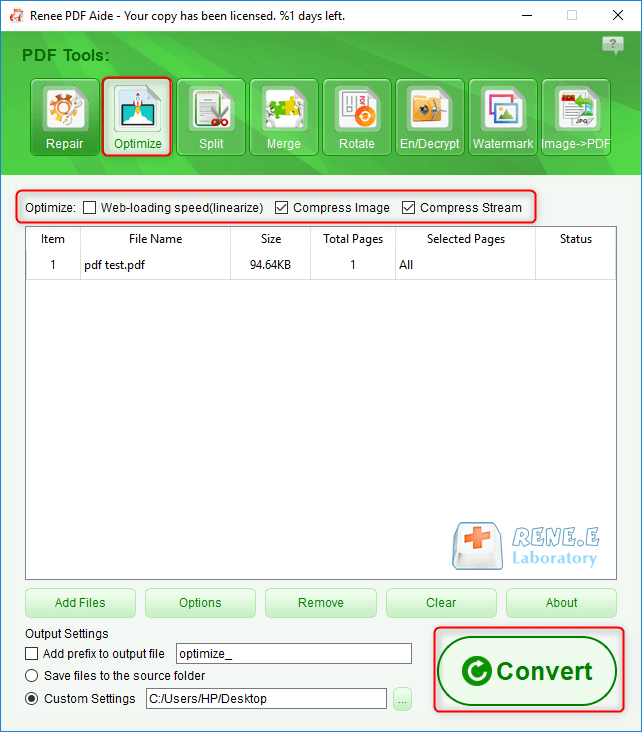
- Online page loading speed (Linearize): Improves first-page load over the web (“Fast Web View”).
- Compress images: Downsizes and recompresses images—the biggest driver of file size.
- Compress data stream: Further compresses internal PDF objects to shrink overall size.
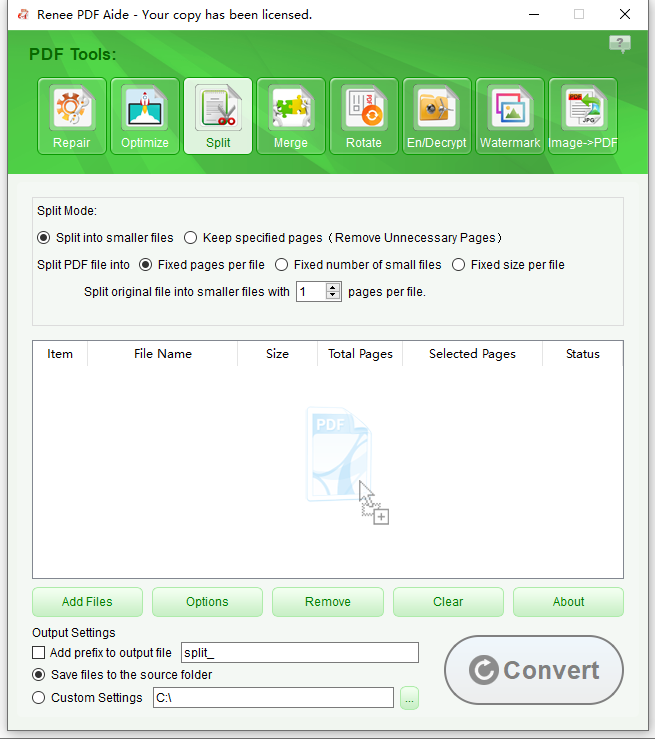
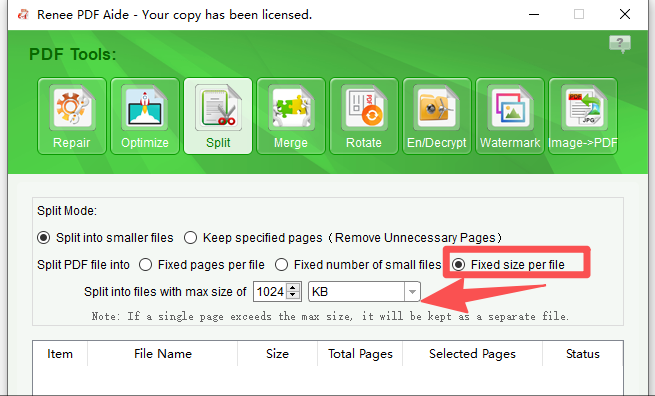
- Split into smaller files: Create multiple files. You can split:
- By equal page counts or into a fixed number of files.
- By maximum file size (best for upload limits like ≤1 MB).
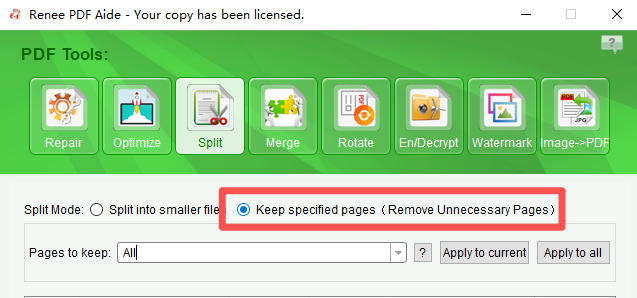
- Keep specified pages: Extract only the pages or ranges you need to keep the file as small as possible.
- Works fully offline for privacy
- Batch compression and OCR for scanned PDFs
- Flexible tools - Optimize, Split by size/pages, Encrypt/Repair
Disadvantages:
- Windows-only
- Paid after the trial
- Advanced tuning options may require a short learning curve
Mini comparison: Renee vs Online vs Acrobat Pro
| Factor | Renee PDF Aide (Windows) | Online Tools (Smallpdf/iLovePDF/Adobe Online) | Adobe Acrobat Pro (Win/Mac) |
|---|---|---|---|
Privacy |
Full offline, local processing |
Files upload to servers |
Full offline, local processing |
Control |
Good (image, stream, linearize; OCR) |
Basic (3 levels) |
Excellent (granular optimizer, fonts, metadata) |
Cost |
Free trial; paid license |
Free tiers; optional subscriptions |
Paid subscription |
Batch/OCR |
Yes/Yes |
Limited batch; no OCR |
Batch via Actions; OCR included |
Learning curve |
Moderate |
Very easy |
Moderate to advanced |
- Instant results via mobile web
- OCR in native apps improves readability at small sizes
- Works on both iOS and Android
Disadvantages:
- Mobile data usage for uploads/downloads
- Free tiers can be limited
- Very small targets may need desktop tools or splitting
Mobile web (no app install)
- Open Smallpdf, iLovePDF, or Adobe Acrobat Online in your mobile browser.
- Upload from Files/Google Drive/iCloud, choose a compression level (Strong/High if you must meet strict limits).
- Download the result to your device or cloud storage.
Native apps (iOS/Android)
- Adobe Scan + Adobe Acrobat Reader: Scan at 150–200 DPI for text documents; enable OCR; open in Acrobat and use Compress (requires subscription for advanced levels).
- Files by Google (Android): Useful to manage space and share files; for compression, pair it with iLovePDF or Adobe apps.
- Apple Files/Shortcuts (iOS): You can create a Shortcut to pass a PDF through an online compressor or Scriptable flow if you prefer automation.
Connectivity and portal tips
- If connectivity is unstable, compress offline or wait for Wi‑Fi.
- Many government portals specify strict limits (≤1MB/≤500KB/≤100KB). Check FAQs, prepare variants, and test uploads.
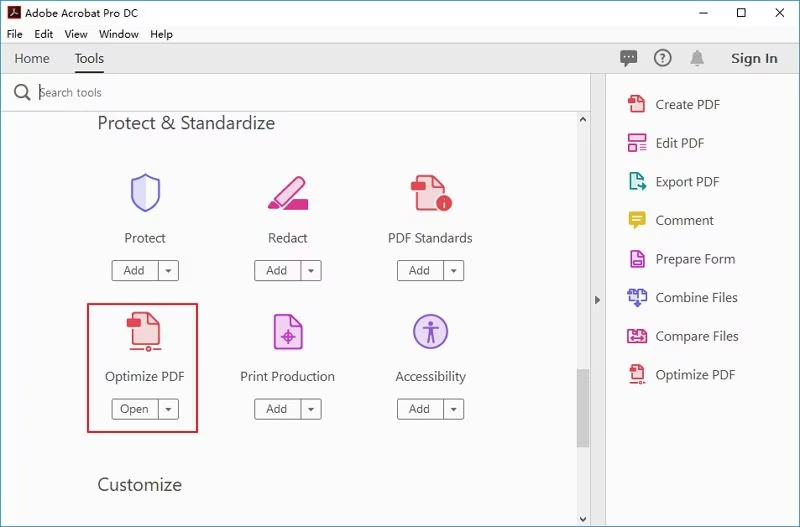
- Maximum control over images, fonts, and metadata
- High-quality results with careful tuning
- Offline processing for privacy
Disadvantages:
- Paid subscription required
- Learning curve for advanced optimizer settings
- Over‑compression possible if settings are too aggressive
- One‑click (fastest):
- File → Save as Other → Reduced Size PDF
- Choose compatibility if prompted and save.
- Custom (recommended when quality matters):
- File → Save as Other → Optimized PDF
- Configure:
- Images: Downsample to 150 DPI for web/email or 300 DPI for print; choose
JPEGorJPEG2000with moderate quality. - Fonts: Subset or remove embedded fonts when safe (don’t remove if it affects appearance).
- Discard objects: Remove unused elements, page thumbnails, embedded files, and hidden layers you don’t need.
- Clean up: Remove metadata, optimize structure, and enable linearization for fast web view.
- Images: Downsample to 150 DPI for web/email or 300 DPI for print; choose
- Already installed on Mac
- Very fast 2-step export
- Custom Quartz filters can improve quality
Disadvantages:
- Default filter can over‑compress images
- Limited control versus Acrobat Pro
- Not ideal for image‑heavy PDFs
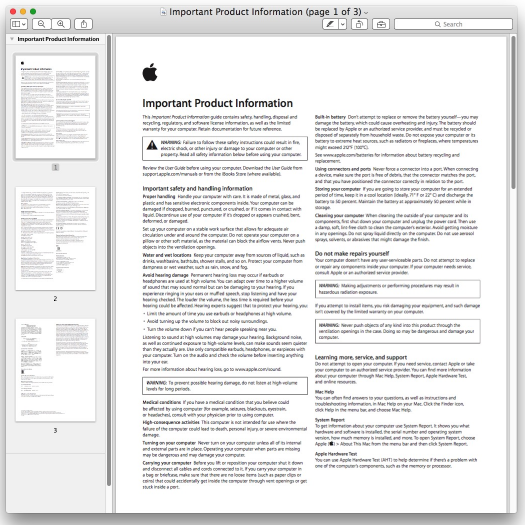
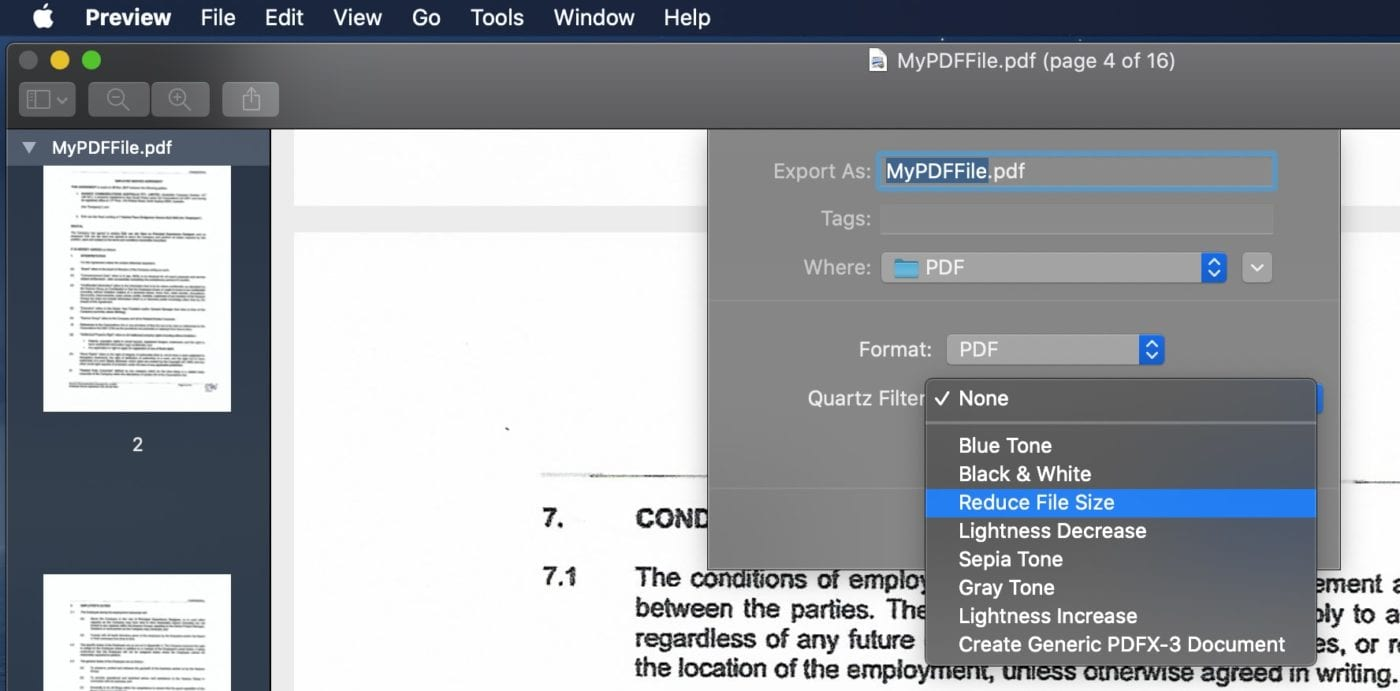
- Open your PDF in Preview → File → Export.
- Set Quartz Filter: Reduce File Size → Save.
- Automates large batches consistently
- Fine-grained control via command-line
- Cross-platform on Windows, macOS, and Linux
Disadvantages:
- Requires command-line familiarity
- Wrong settings can degrade quality
- Testing and backups are essential
Steps
- Install Ghostscript from the official site and add it to your system PATH.
- Start with a single file: run a balanced command targeting about
150DPI for color/gray images and review quality. - Set up batch commands (Bash or PowerShell) to process multiple PDFs into a “compressed_” output folder.
- Iterate to target sizes by lowering DPI to
120or96only if needed; validate fonts, colors, and diagrams before rolling out.
gs -sDEVICE=pdfwrite -dCompatibilityLevel=1.6 -dPDFSETTINGS=/ebook \\
-dColorImageDownsampleType=/Bicubic -dColorImageResolution=150 \\
-dGrayImageDownsampleType=/Bicubic -dGrayImageResolution=150 \\
-dMonoImageDownsampleType=/Subsample -dMonoImageResolution=300 \\
-dDetectDuplicateImages=true -dCompressFonts=true \\
-o output.pdf input.pdf
for f in *.pdf; do
gs -sDEVICE=pdfwrite -dCompatibilityLevel=1.6 -dPDFSETTINGS=/ebook \\
-dColorImageResolution=150 -dGrayImageResolution=150 \\
-o "compressed_$f" "$f"
done
Get-ChildItem *.pdf | ForEach-Object {
$out = "compressed_$($_.Name)"
gs -sDEVICE=pdfwrite -dCompatibilityLevel=1.6 -dPDFSETTINGS=/ebook `
-dColorImageResolution=150 -dGrayImageResolution=150 `
-o $out $_.FullName
}
- Start with
150DPI for color/gray images, then adjust to120or96DPI if still too large; review quality each step. - Consider
-dPDFSETTINGS=/screenonly for aggressive cuts; expect notable image degradation.
qpdf --linearizeimproves “Fast Web View” but won’t shrink large images meaningfully.- Color profiles and transparency flattening can alter appearance—test on a few pages first.
How to compress PDF without losing quality?
How to compress scanned PDF?
How to compress PDF to 100KB?
Why didn’t ZIP make my PDF smaller?
Convert to Editable Word/Excel/PPT/Text/Image/Html/Epub
Multifunctional Encrypt/decrypt/split/merge/add watermark
OCR Support Extract Text from Scanned PDFs, Images & Embedded Fonts
Quick Convert dozens of PDF files in batch
Compatible Support Windows 11/10/8/8.1/Vista/7/XP/2K
Convert to Editable Word/Excel/PPT/Text/Image/Html/Epub
OCR Support Extract Text from Scanned PDFs, Images & Embedded
Support Windows 11/10/8/8.1/Vista/7/XP/2K
Relate Links :
[2026 Updated] How to Compress Your PDF File for Easy Email Sending?

01-02-2026
Amanda J. Brook : This guide covers multiple approaches to how to compress PDF files, including online tools for quick results, offline...
Best Bulk PDF Converter Tools: Quickly & Easily Convert Multiple Files
20-11-2025
Amanda J. Brook : Discover the best bulk PDF converter tools to save time and boost productivity. Compare top free and paid...
Repair Damaged PDF Files: Simple Solutions
30-01-2024
Amanda J. Brook : Learn how to repair damaged PDF files to ensure that you can open and view the content. Follow...
Convert ASPX to PDF: A Simple Guide
10-10-2023
Amanda J. Brook : Learn how to convert ASPX files to PDF with a simple method, allowing for easier use and transfer....



User Comments
Leave a Comment