author avatar
    Senior Product Manager
Last update by William Davis at 7 September 2026

Summary
This article outlines technical procedures for resolving an Intel VMD controller cloning BSOD, focusing on BIOS configuration adjustments and storage driver repairs. It details systematic troubleshooting steps, including Safe Mode driver updates, DISM injection, and verified re-cloning methodologies to restore boot functionality.


An Intel VMD controller cloning BSOD—typically the INACCESSIBLE_BOOT_DEVICE error—often appears after cloning Windows to a new SSD on a modern Intel system. This guide will walk you through BIOS mode adjustments, storage driver repairs, boot order cleanup, and safe re-cloning options to help your cloned drive boot independently, all without needing to reinstall Windows.
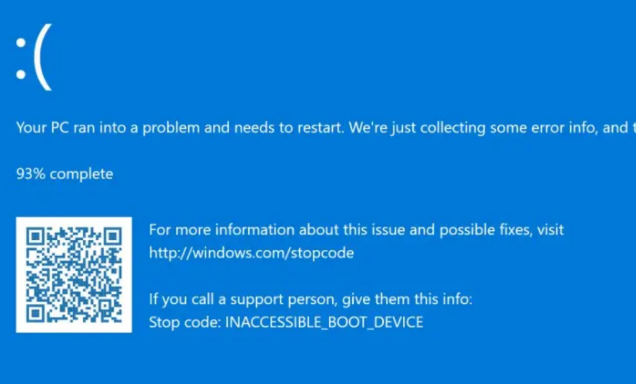
INACCESSIBLE BOOT DEVICE

Important: Always suspend BitLocker before changing BIOS storage modes to avoid lockout or data loss.

Quick fixes for Intel VMD cloning BSOD

After cloning Windows to an NVMe or SATA SSD, the process may appear successful, yet the system can still fail to boot. A blue screen with INACCESSIBLE_BOOT_DEVICE usually indicates that Windows cannot communicate with the storage controller in its current Intel VMD/RST mode, or that remnants of the original drive configuration are interfering with startup.

The core issue is that the original HDD or SSD was properly registered in the BIOS and worked seamlessly with Windows. Once replaced, the new drive may not be recognized under the correct RST/VMD settings. Instead, the BIOS often defaults to generic storage options, leaving Windows unable to load the proper controller driver. In some cases, cloning software may also mishandle system settings, causing Windows to misconfigure its boot parameters.

Quick Test 1: Toggle Intel VMD/RST mode in BIOS
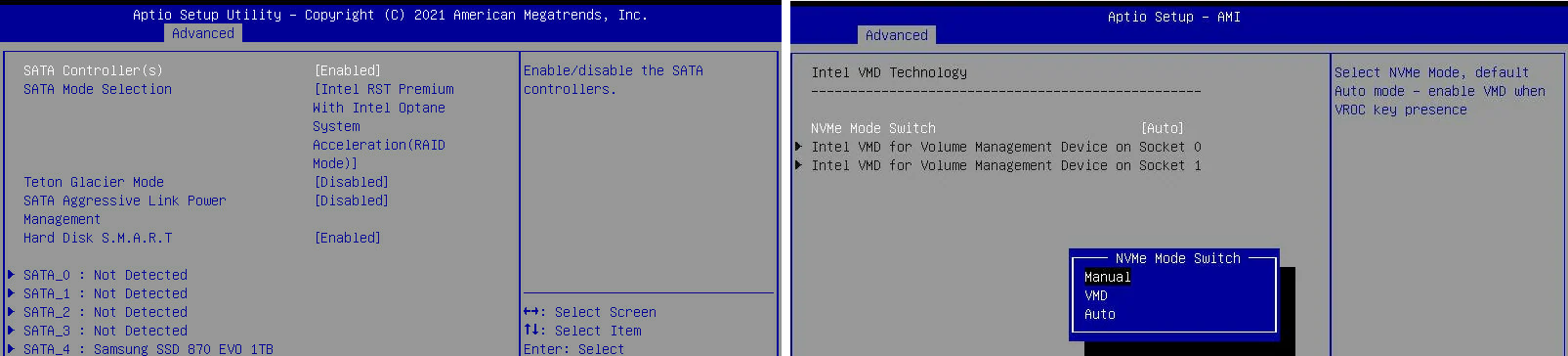
If the original Windows was installed with VMD enabled but you try to boot the clone with VMD disabled (or vice versa), Windows may immediately fail. In BIOS, switch to the matching Intel VMD, RST, RAID, or AHCI setting as used by the source system.
toggle intel vmd or rst mode in BIOS

Quick Test 2: Physically disconnect the original source drive.

This prevents duplicate disk signatures, conflicting boot entries, and drive letter confusion. Only leave the cloned drive connected during testing.
Note: BIOS menu names vary by manufacturer. Look for Intel VMD, Intel RST, RAID, SATA/NVMe mode, or VMD Setup.
If these quick fixes don’t resolve the issue, continue with the detailed step-by-step guide below.

Step-by-step: fix the cloned drive and boot Windows again

Warning: Re-cloning will erase the target disk. Suspend BitLocker and back up all important data before proceeding.

1. Safety checks and backup preparation

Before changing BIOS storage modes or re-cloning, protect your data and avoid encryption lockouts.

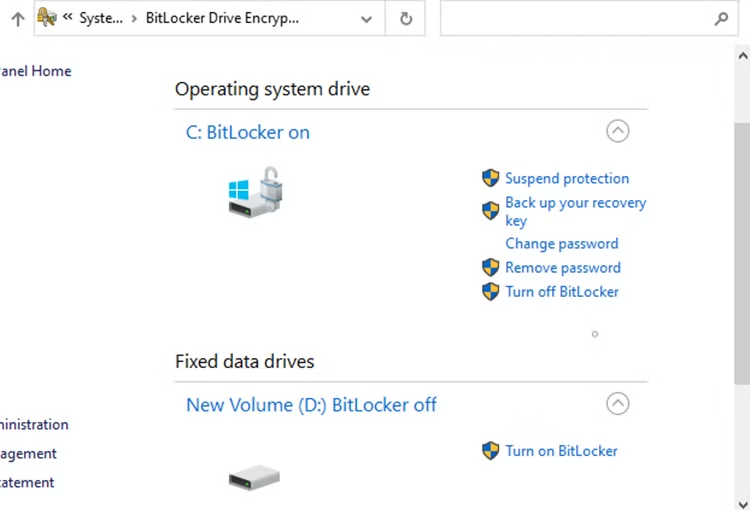
Suspend BitLocker

1. Open Control Panel and navigate to BitLocker Drive Encryption.
2. Choose the encrypted drive.
3. Click Suspend protection and confirm.
BitLocker Drive Encryption with Suspend protection option
4. Leave BitLocker suspended until you confirm the clone boots normally.
On newer Windows 11/10 devices, you may find this under Settings > Privacy & security > Device encryption.

Prepare a recovery path

- Connect an external backup drive and copy your most important files.
- Create a Windows recovery drive if Windows is still accessible.
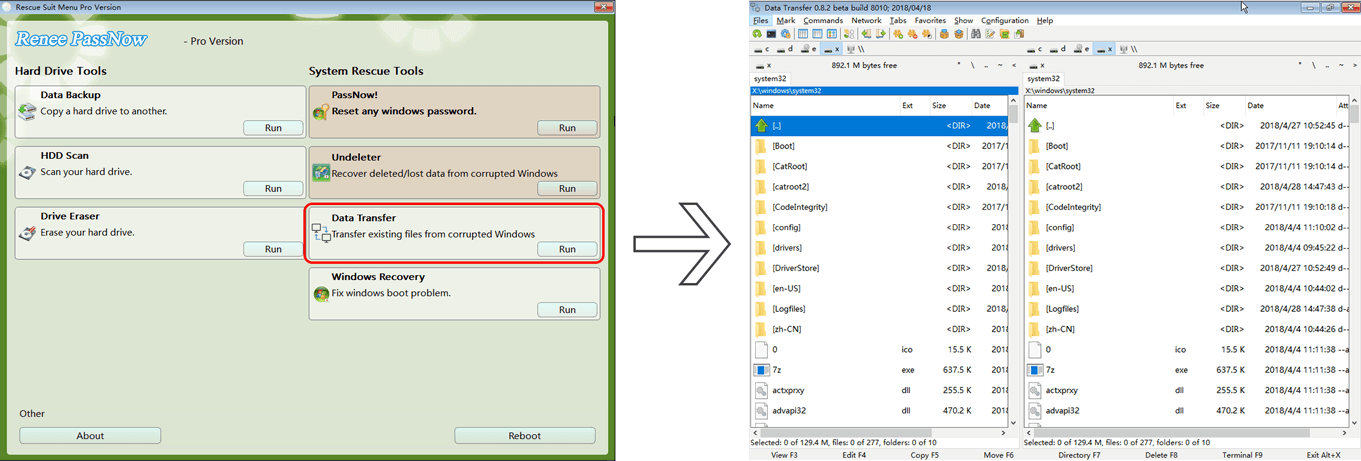
- If you can’t access Windows or WinRE, prepare to boot from a Renee PassNow Rescue Disk.
Data transfer function of Renee PassNow

2. Disconnect the original drive and verify boot order

The goal is to ensure the cloned disk is the only bootable drive during testing.
1. Shut down the computer fully and unplug the power cable.
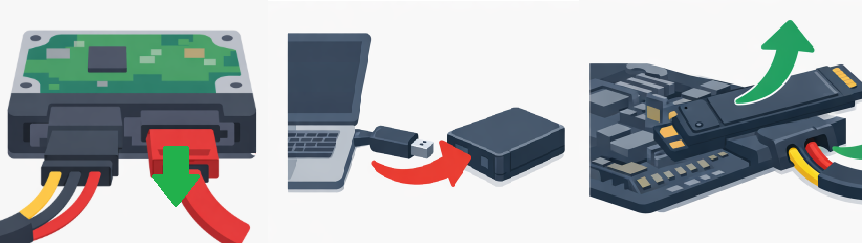
2. Carefully remove the original system drive. On desktops, disconnect the SATA or NVMe source drive. On some laptops, disabling the source drive in BIOS may be necessary.
Unplugging SATA cable from a hard drive
4. Reconnect power and turn on the PC.
5. Enter BIOS/UEFI by pressing the appropriate key at startup (Del, F2, F10, or Esc are common).
6. Locate the Boot menu and set the cloned target drive as the first boot device.
BIOS startup tab with boot device order on a Lenovo laptop
7. Save changes and exit BIOS.
If you must leave the original drive connected for any reason, ensure the cloned drive is first in the boot order.

3. Toggle Intel VMD in BIOS to match the driver

The VMD setting determines how Windows communicates with NVMe and SATA storage. A mismatch between BIOS storage mode and the Windows driver is a common cause of the INACCESSIBLE_BOOT_DEVICE error after cloning.
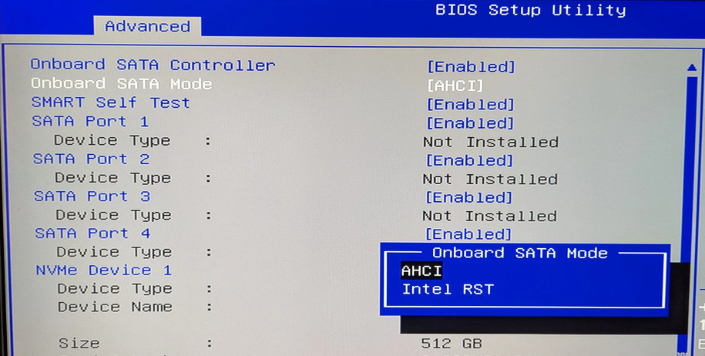
1. Enter BIOS/UEFI as described above.
2. Navigate to Advanced, System Configuration, Storage, or Intel VMD Setup—the exact location varies by manufacturer.
SATA Controller mode
3. Locate the Intel VMD/RST mode setting.
4. Set Intel VMD Off if the cloned Windows was installed in AHCI/standard NVMe mode.
5. Set Intel VMD On or RST mode if the cloned Windows uses the Intel RST/VMD driver.
6. Save and restart.

Which BIOS mode matches the driver?

Cloned Windows storage driver BIOS storage mode to try

Standard Microsoft AHCI/NVMe driver

Intel VMD Off or AHCI mode

Intel RST/VMD driver with iaStorVD.sys

Intel VMD On or RST mode

If you’re unsure which driver your clone uses, try one mode, restart, and if that fails, try the other.

4. Re-clone with Renee Becca (If the clone still fails)

If toggling VMD settings and repairing drivers doesn’t resolve the boot issue, the cloned system image may be corrupt or the storage stack too inconsistent. At this point, re-cloning is usually safer than trying to patch a failing clone.

Renee Becca overview

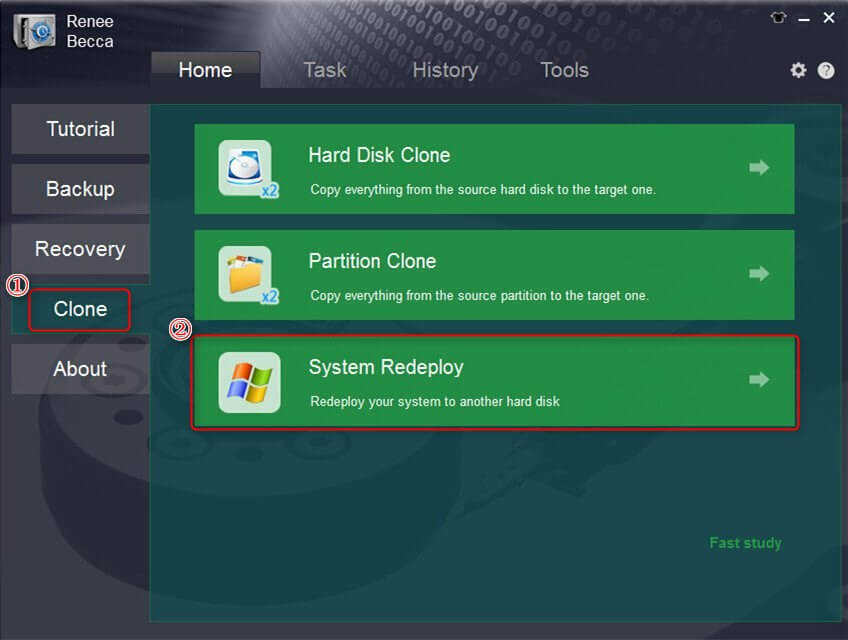
Renee Becca is a Windows backup, restore, and disk cloning tool that supports full system images, file-level backup, hard disk/partition backup, and system migration. Its System Redeploy feature moves only the Windows system partition to a new drive—ideal when upgrading to an SSD without reinstalling Windows. The Hard Disk Clone option copies all partitions and volumes for a complete drive replacement. Renee Becca also supports partition resizing, scheduled backups, incremental/differential backup modes, BitLocker suspension guidance, and bootable rescue disk creation.
select system redeploy function in clone
Advantages:
  • Simple, clear interface for users of all skill levels
  • Multiple backup and cloning options for disks, partitions, system-only, or files
  • Supports partition resizing during clone operations
  • Incremental and differential backups save time and disk space
  • Free for non-Windows disk cloning operations

Disadvantages:

  • Windows-only software; Mac and Linux users require alternatives
  • Advanced features may require purchase after the trial
  • System migration requires the target drive capacity to exceed the source system size
  • All data on the target disk is erased during migration or cloning

Upgrade to SSD with Renee Becca – Fix Intel VMD Clones Instantly

Automatic 4K alignment Improves SSD performance during system migration.

Support GPT and MBR Automatically adapt to the suitable partition format.

Support NTFS and FAT32 Redeploy various files in different file systems.

Back up quickly Back up files at up to 3,000MB/min.

Overall backup schedule Support system redeployment/system backup/partition backup/disk backup/disk clone.

Automatic 4K alignment Improve SSD performance

Support GPT and MBR Intelligently adapt to a partition format

Support NTFS and FAT32 Redeploy files in different file systems

Free TrialFree TrialNow 56337 people have downloaded!

FAQ

What is the difference between VMD and AHCI mode, and which should I keep after cloning?

VMD mode uses the Intel Volume Management Device to manage NVMe and SATA controllers, typically requiring the Intel RST/VMD driver. AHCI mode uses the standard Microsoft storage driver stack. After cloning, use the mode that matches how Windows was installed on the cloned drive: VMD Off/AHCI for AHCI-based installs, VMD On for RST/VMD-based installs.

What does theiaStorVD.sysBSOD mean and how does it relate to Intel VMD/RST?

iaStorVD.sys is the Intel RST VMD driver. A BSOD or Device Manager warning related to iaStorVD.sys means Windows is trying to load a VMD driver that is missing, incompatible, or not supported in the current BIOS mode. The fix is to align the BIOS storage mode with the driver, update the driver in Safe Mode, or inject the correct driver from WinRE.

Can Safe Mode bypass the VMD driver failure after cloning?

Safe Mode often bypasses third-party storage driver failures by loading a minimal driver set. If the clone starts in Safe Mode but not in normal mode, the issue is likely with a driver or service conflict. Use Safe Mode to update the Intel RST/VMD driver or adjust the BIOS storage mode.

Is removing the old drive enough to fix post-clone boot conflicts?

Removing the old drive eliminates duplicate disk signatures and boot-entry conflicts, but it won’t resolve a VMD/RST driver mismatch. It’s a good first step after cloning but may need to be combined with BIOS storage mode changes or driver repairs.

Do I need to re-clone with Renee Becca, or are BIOS/driver fixes sufficient?

If your cloned Windows boots after changing BIOS mode or repairing the driver, you don’t need to re-clone. If the stop error continues, the system image may be too damaged or the driver mismatch too complex for manual repair. In that case, re-cloning with Renee Becca—using System Redeploy or Hard Disk Clone—offers a cleaner, more reliable migration.
Renee Becca – Safe and Quick System Migration to SSD

Automatic 4K alignment Improves SSD performance during system migration.

Support GPT and MBR Automatically adapt to the suitable partition format.

Support NTFS and FAT32 Redeploy various files in different file systems.

Back up quickly Back up files at up to 3,000MB/min.

Overall backup schedule Support system redeployment/system backup/partition backup/disk backup/disk clone.

Automatic 4K alignment Improve SSD performance

Support GPT and MBR Intelligently adapt to a partition format

Support NTFS and FAT32 Redeploy files in different file systems

Free TrialFree TrialNow 56337 people have downloaded!

User Comments

Page 1

Leave a Comment


Your comment has been submitted and is awaiting moderation.